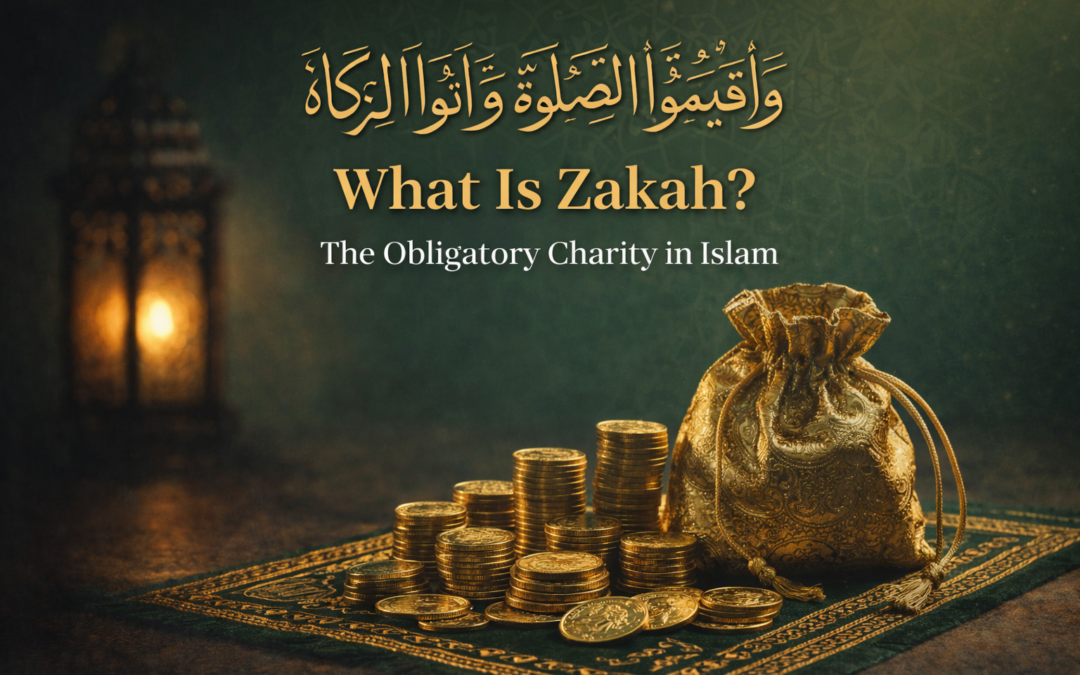
What Is Zakah?
Zakah is the third pillar of Islam. It is an obligatory form of charity that eligible Muslims must give each year from their savings.
The word “Zakah” means purification and growth. By giving a portion of wealth to those in need, a Muslim purifies their heart from greed and helps create balance in society.
The Prophet ﷺ said:
“Islam is built upon five… establishing prayer and giving zakah…”
(Sahih al-Bukhari 8; Sahih Muslim 16)
This shows that Zakah is not optional charity — it is a fundamental pillar of the faith.
Why Does Islam Require Zakah?
Islam recognises that wealth is a trust from Allah.
The Qur’an says:
“And establish prayer and give zakah…”
(Qur’an 2:110)
And:
“Take from their wealth a charity by which you purify them and cause them increase…”
(Qur’an 9:103)
Zakah purifies both the giver and the wealth itself. It reminds believers that everything they own ultimately belongs to Allah.
Who Must Pay Zakah?
Zakah is required from Muslims who meet a minimum wealth threshold known as the nisab. If a person’s savings remain above that threshold for one lunar year, they give a fixed percentage (commonly 2.5%) of their qualifying savings.
It is not required from:
- Those in debt
- Those struggling financially
- Those below the minimum threshold
Islam does not burden people beyond their ability.
Allah says:
“Allah does not burden a soul beyond what it can bear.”
(Qur’an 2:286)
Who Receives Zakah?
The Qur’an clearly defines who is eligible to receive Zakah:
“Zakah expenditures are only for the poor, the needy, those employed to collect it, those whose hearts are to be reconciled, for freeing captives, for those in debt, for the cause of Allah, and for the stranded traveler…”
(Qur’an 9:60)
This verse ensures that Zakah is distributed with fairness and purpose.
It is not random charity — it is structured social support.
The Spiritual Impact of Giving
Zakah protects the heart from attachment to wealth.
The Prophet ﷺ said:
“Charity does not decrease wealth.”
(Sahih Muslim 2588)
Although giving may appear to reduce money outwardly, Islam teaches that it brings spiritual blessing (barakah) and long-term benefit.
Wealth in Islam is not condemned — but hoarding and selfishness are.
The Qur’an warns:
“And those who hoard gold and silver and do not spend it in the way of Allah — give them tidings of a painful punishment.”
(Qur’an 9:34)
Zakah protects a believer from this spiritual danger.
Zakah vs. Voluntary Charity (Sadaqah)
It is important to distinguish between:
- Zakah – obligatory annual charity
- Sadaqah – voluntary charity given anytime
Both are rewarded, but Zakah is a pillar of Islam.
The Prophet ﷺ said:
“Protect yourselves from the Fire, even with half a date in charity.”
(Sahih al-Bukhari 1417; Sahih Muslim 1016)
This shows that even small acts of giving carry immense value.
The Social Wisdom of Zakah
Zakah reduces poverty.
It strengthens communities.
It creates empathy.
It redistributes wealth ethically.
Islam does not leave social justice to chance — it makes generosity part of faith.
A society that practices Zakah regularly reduces extreme inequality and strengthens compassion.
Zakah: A Reminder of Trust
At its heart, Zakah reminds the believer:
- Wealth is temporary.
- Life is temporary.
- Accountability is real.
Giving purifies attachment and increases gratitude.
It transforms wealth from a potential burden into a source of reward.
Conclusion
Zakah is not merely financial — it is spiritual.
It purifies wealth.
It purifies the heart.
It strengthens society.
By giving a portion of what we love, we draw closer to the One who gave it to us in the first place.
And through Zakah, generosity becomes an act of worship.