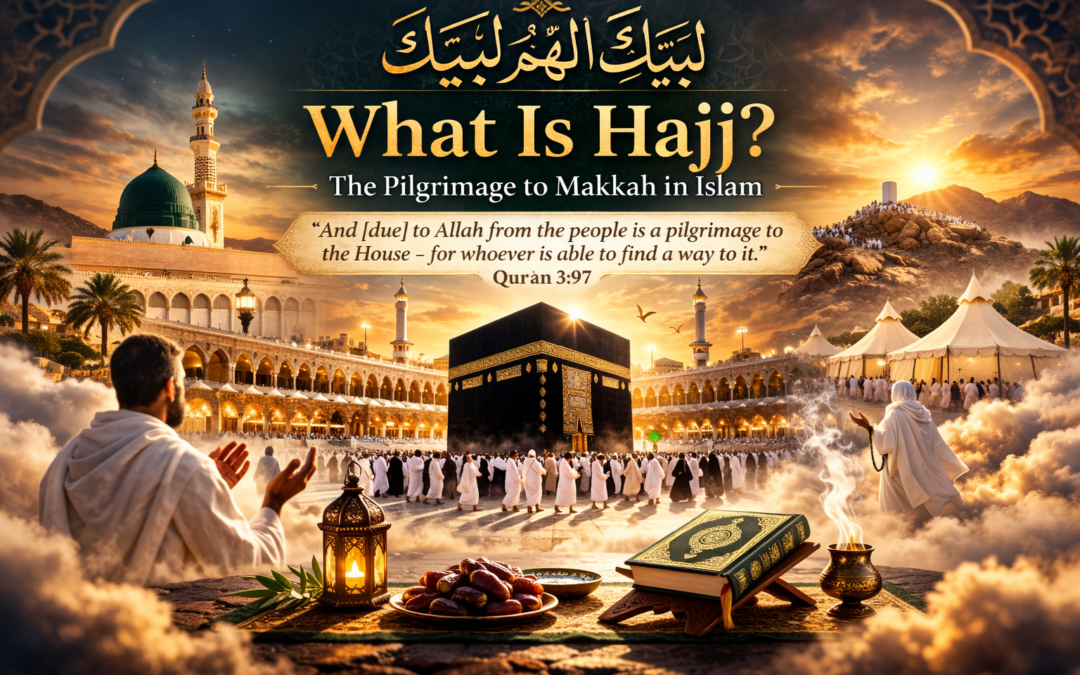
What Is Hajj?
Hajj is the pilgrimage to the city of Makkah in Saudi Arabia. It is the fifth pillar of Islam and is required once in a lifetime for Muslims who are physically and financially able.
Each year, millions of Muslims from around the world gather to perform this sacred journey. Despite differences in language, culture, and background, they stand together in unity — worshipping one God.
The Prophet ﷺ said:
“Islam is built upon five… and pilgrimage to the House.”
(Sahih al-Bukhari 8; Sahih Muslim 16)
This places Hajj among the foundational pillars of the faith.
Why Do Muslims Perform Hajj?
Hajj is an act of obedience to Allah and a powerful reminder of human equality, humility, and accountability.
Allah commands in the Qur’an:
“And [due] to Allah from the people is a pilgrimage to the House — for whoever is able to find a way to it.”
(Qur’an 3:97)
The “House” refers to the Ka‘bah — the sacred structure in Makkah built by Prophet Ibrahim (Abraham) and his son Ismail (peace be upon them).
Hajj connects Muslims to a legacy of prophets and centuries of worship.
When Is Hajj Performed?
Hajj takes place during specific days in the Islamic month of Dhul-Hijjah, the final month of the lunar calendar.
It is not performed at any time of year — only during these appointed days.
What Happens During Hajj?
Hajj consists of a series of rituals that symbolise submission and remembrance.
Among them are:
- Ihram – entering a sacred state of simplicity
- Tawaf – walking around the Ka‘bah
- Sa‘i – walking between the hills of Safa and Marwah
- Standing at ‘Arafah – a day of prayer and supplication
- Stoning the pillars – symbolising rejection of evil
- Sacrifice – commemorating Prophet Ibrahim’s obedience
The Day of ‘Arafah is especially significant.
The Prophet ﷺ said:
“Hajj is ‘Arafah.”
(Sunan al-Tirmidhi 889 – authenticated as sahih)
This day represents humility before Allah and intense supplication.
The Spiritual Meaning of Hajj
Hajj strips away worldly distinctions.
Pilgrims wear simple white garments (ihram), symbolising:
- Equality
- Simplicity
- The shroud of burial
- The Day of Judgment
Standing among millions, a person reflects on life’s temporary nature and the reality of standing before Allah.
The Qur’an reminds pilgrims:
“And take provisions, but indeed, the best provision is taqwa (God-consciousness).”
(Qur’an 2:197)
The true goal of Hajj is spiritual transformation — not tourism.
The Reward of Hajj
Hajj carries immense spiritual reward.
The Prophet ﷺ said:
“Whoever performs Hajj for Allah and does not engage in sexual relations or commit sin will return like the day his mother gave birth to him.”
(Sahih al-Bukhari 1521; Sahih Muslim 1350)
This means that sincere Hajj wipes away previous sins.
It is a complete spiritual renewal.
Who Is Required to Perform Hajj?
Hajj is required only for those who are:
- Muslim
- Adult
- Physically able
- Financially capable
It is not required from those who cannot afford it or are unable to travel.
Islam does not impose hardship.
Allah says:
“Allah intends for you ease and does not intend for you hardship.”
(Qur’an 2:185)
Hajj: A Global Gathering of Faith
Hajj is one of the largest annual gatherings in the world.
People of every race and background stand side by side — equal before Allah.
It demonstrates the unity of Islam and the shared purpose of humanity: to worship the Creator alone.
Conclusion
Hajj is more than a journey of miles — it is a journey of the heart.
It teaches:
- Humility
- Equality
- Patience
- Obedience
- Accountability
For those who complete it sincerely, it marks a turning point in life.
Through Hajj, the believer returns renewed — with a deeper awareness of Allah and a clearer sense of purpose.