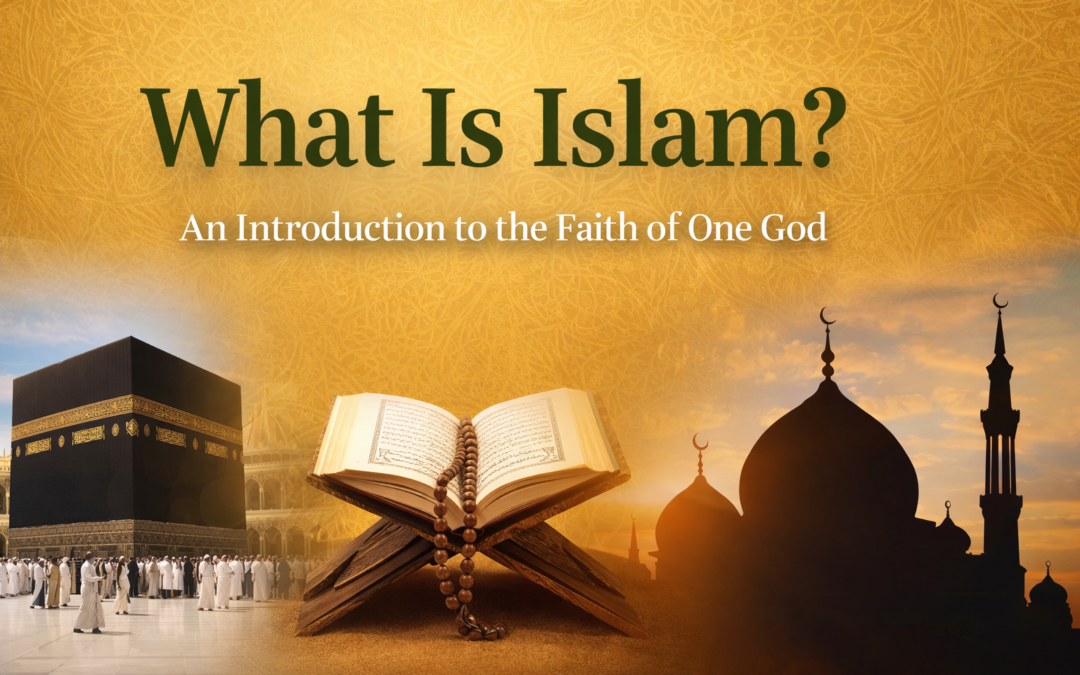
🕌 What Is Islam? A Complete and Clear Introduction
Introduction
Islam is one of the world’s fastest-growing religions, followed by nearly two billion people across every continent. Yet despite its global presence, many people still ask:
What is Islam really about?
Is it simply a religion of rituals?
Is it a culture?
Is it a legal system?
Or is it something deeper?
Islam is a complete way of life built upon belief in One God, moral responsibility, and accountability in the hereafter. It offers spiritual guidance, ethical principles, and practical laws designed to bring balance between the individual and society.
This article explains Islam clearly and authentically — for anyone seeking understanding.
The Meaning of the Word “Islam”
The word Islam comes from the Arabic root word S-L-M, which relates to:
- Peace
- Safety
- Submission
Islam means:
Submission to the Will of the One True God.
This submission is not blind or forced. It is a conscious, willing acceptance of the Creator’s guidance.
A person who practices Islam is called a Muslim, which means:
“One who submits to God.”
The Core Belief of Islam: Tawheed (Oneness of God)
At the heart of Islam is one simple, powerful declaration:
There is no god worthy of worship except Allah, and Muhammad ﷺ is His messenger.
This belief is known as Tawheed — the Oneness of God.
Muslims believe:
- God is One.
- He has no partners.
- He is not human.
- He was not born.
- He does not have children.
- Nothing resembles Him.
God is unique, eternal, and independent.
This pure monotheism is the foundation of Islam.
Who Is Allah?
“Allah” is simply the Arabic word for God.
Arab Christians and Jews also use the word Allah.
In Islam, Allah is:
- The Creator of the universe
- The Most Merciful
- The All-Knowing
- The Just
- The All-Powerful
Muslims believe God is directly accessible. There are no intermediaries, no saints, and no priests required to speak to Him.
Prayer in Islam is direct.
Prophets in Islam
Islam teaches that God did not leave humanity without guidance.
Throughout history, He sent prophets to different nations with the same core message:
Worship One God alone.
Among the prophets Muslims believe in are:
- Adam
- Noah
- Abraham
- Moses
- David
- Jesus (peace be upon them all)
Muslims believe that Prophet Muhammad ﷺ is the final messenger, sent to all of humanity.
The Qur’an: The Final Revelation
The Qur’an is the holy book of Islam.
Muslims believe it is:
- The literal word of God
- Revealed to Prophet Muhammad ﷺ
- Preserved unchanged for over 1400 years
The Qur’an provides guidance on:
- Belief and worship
- Morality and character
- Family life
- Justice and society
- Personal development
- Accountability in the afterlife
It is recited daily by millions around the world.
The Five Pillars of Islam
Islam is built upon five foundational acts known as the Five Pillars.
1. Shahada (Declaration of Faith)
To testify that there is no god but Allah and Muhammad ﷺ is His messenger.
2. Salah (Prayer)
Five daily prayers that connect a Muslim to God.
3. Zakah (Charity)
Giving a portion of wealth to support the poor and needy.
4. Sawm (Fasting in Ramadan)
Fasting from dawn to sunset during the month of Ramadan.
5. Hajj (Pilgrimage to Makkah)
A once-in-a-lifetime pilgrimage for those who are physically and financially able.
These pillars build discipline, gratitude, humility, and social responsibility.
Is Islam Just a Religion?
Islam is not limited to rituals.
It is a complete way of life that addresses:
- Spirituality
- Ethics
- Economics
- Social justice
- Personal conduct
- Family structure
Islam encourages balance:
Between worship and work.
Between rights and responsibilities.
Between individual freedom and social accountability.
What Does Islam Teach About Peace?
The root of the word Islam relates to peace.
True peace in Islam comes through:
- Submission to God
- Justice
- Moral conduct
- Self-discipline
The Qur’an teaches:
Saving one life is like saving all of humanity.
Oppression is forbidden.
Justice is mandatory.
Mercy is encouraged.
Women in Islam
Islam granted women rights in the 7th century that were revolutionary for their time:
- Right to own property
- Right to inheritance
- Right to education
- Right to consent in marriage
Islam views men and women as spiritually equal before God.
The Afterlife in Islam
Islam teaches that this life is temporary.
After death, every individual will be held accountable for their actions.
There will be:
- A Day of Judgment
- Justice for all
- Paradise for the righteous
- Punishment for wrongdoing
This belief creates moral responsibility.
Why Do So Many People Accept Islam?
Many converts to Islam say they were drawn to:
- The simplicity of pure monotheism
- The direct relationship with God
- The clarity of purpose
- The moral framework
- The preserved scripture
Islam answers fundamental questions:
- Why am I here?
- Who created me?
- What happens after death?
Conclusion
Islam is the belief in One God and living according to His guidance.
It is a faith built on:
- Mercy
- Justice
- Accountability
- Balance
- Purpose
At its heart, Islam invites humanity to return to the Creator and live a life of meaning.
If you are curious about Islam, continue learning. Seek knowledge. Ask questions.
Understanding begins with sincerity.