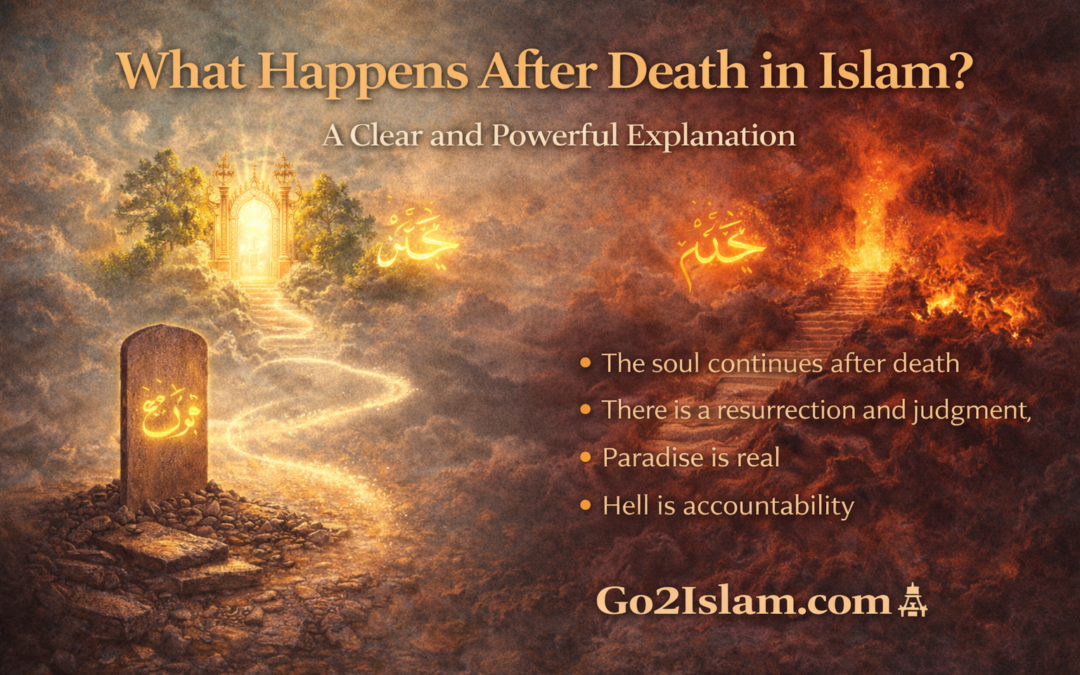
Introduction
Death is the one certainty every human being shares.
It does not matter:
- Age
- Wealth
- Status
- Belief
Every soul will taste death.
But what happens after that?
Is death the end?
Is it unconscious nothingness?
Is there judgment?
Is there heaven and hell?
Islam provides a detailed and structured understanding of what happens after death — and it forms a central part of Muslim belief.
Death Is Not the End
In Islam, death is not annihilation.
It is transition.
The Qur’an describes this world as temporary and the next life as eternal.
This life is a stage.
The next life is the destination.
The Moment of Death
Islam teaches that when a person dies:
- The Angel of Death takes the soul.
- The soul separates from the body.
- The body remains in this world.
- The soul continues into another realm.
For the righteous, this moment is described as peaceful.
For the wicked, it is described as difficult.
But in both cases, the soul continues to exist.
The Grave (Barzakh)
After death, the soul enters a stage called Barzakh.
Barzakh is an intermediate state between this world and the Day of Judgment.
In this stage:
- The soul becomes aware of its situation.
- It experiences comfort or distress depending on its faith and actions.
- It waits for resurrection.
This stage is unseen by the living — but is described in Islamic teachings as real and conscious.
The Day of Judgment
One of the core beliefs in Islam is that all humans will be resurrected.
On the Day of Judgment:
- Every soul will rise from the grave.
- All actions will be accounted for.
- Nothing will be hidden.
- Justice will be complete.
The Qur’an repeatedly emphasises that:
Not even the smallest deed will be ignored.
Good and evil are weighed with absolute fairness.
Divine Justice
Many people struggle with injustice in this world:
- Oppressors who escape punishment
- Innocent people who suffer
- Crimes that go unanswered
Islam teaches that ultimate justice does not end at death.
The afterlife completes what this world cannot.
No injustice is forgotten.
No suffering is wasted.
No wrongdoing escapes accountability.
Heaven (Paradise)
For those who believed and lived righteously, the final destination is Paradise.
Paradise is described as:
- Peaceful
- Beautiful
- Free of fear
- Free of pain
- Free of injustice
- Eternal
The Qur’an describes gardens, flowing rivers, comfort, joy, and closeness to God.
But the greatest reward is described as:
God’s pleasure and nearness.
Paradise is not just luxury — it is perfect peace.
Hell (Accountability)
Islam also teaches that there is Hell — a place of punishment for those who rejected truth and committed evil without repentance.
This is not described casually.
It is presented as:
- A place of justice
- A consequence of deliberate wrongdoing
- A manifestation of moral accountability
Islam teaches that God is:
- Just
- Merciful
His mercy is vast.
But justice remains real.
Is the Afterlife Only for Muslims?
Islam teaches that:
- Faith matters.
- Actions matter.
- Sincerity matters.
- Knowledge and intention matter.
God judges with perfect knowledge — humans do not.
Ultimate judgment belongs to God alone.
Why Belief in the Afterlife Changes Everything
If death were the end:
- Injustice would win.
- Goodness would often go unrewarded.
- Suffering would be meaningless.
Belief in the afterlife:
- Gives weight to morality.
- Gives hope to the oppressed.
- Gives restraint to the powerful.
- Gives purpose to sacrifice.
It transforms how a person lives.
Facing Death Without Fear
Islam does not teach obsession with death.
It teaches preparation for it.
A believer who:
- Seeks forgiveness
- Lives sincerely
- Strives to do good
Is encouraged to view death as:
A meeting with their Creator.
Not annihilation.
Conclusion
What happens after death in Islam?
- The soul continues.
- There is a waiting stage (Barzakh).
- Resurrection will occur.
- Judgment will be delivered.
- Paradise or accountability follows.
Death is not the end of the story.
It is the beginning of the permanent one.
What happens immediately after death in Islam?
The soul is taken by the Angel of Death and enters a state called Barzakh, where it awaits the Day of Judgment.
Does Islam believe in resurrection?
Yes. Islam teaches that all humans will be resurrected and judged for their actions.
What is Barzakh?
Barzakh is the intermediate state between death and the Day of Judgment.
Is Paradise eternal in Islam?
Yes. Paradise is described as eternal for those admitted into it.
Is death the end according to Islam?
No. Death is a transition to the afterlife, not annihilation.