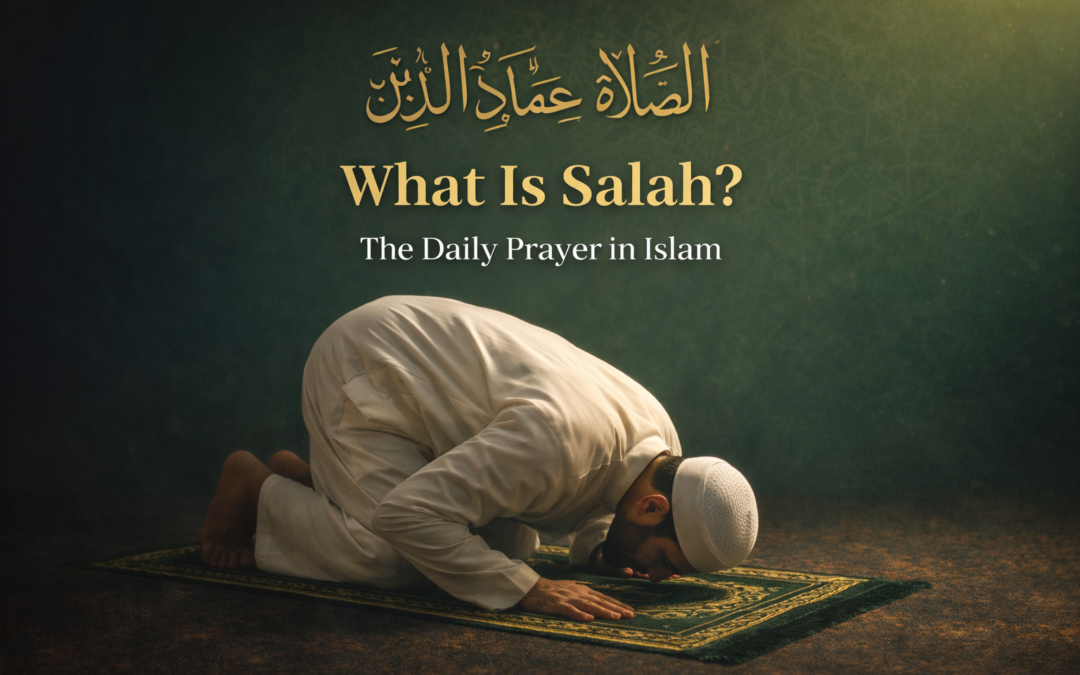
Salah is the formal prayer performed five times a day by Muslims. It is the second pillar of Islam and the most consistent act of worship in a believer’s life.
More than a ritual, Salah is a direct connection between a person and their Creator. It is a moment of pause in the day — a reminder of purpose, humility, and gratitude.
The Prophet Muhammad ﷺ said:
“Islam is built upon five… establishing the prayer…”
(Sahih al-Bukhari 8; Sahih Muslim 16)
This shows that prayer is not optional in Islam — it is foundational.
The Five Daily Prayers
Muslims pray five times each day:
- Fajr – before sunrise
- Dhuhr – midday
- Asr – afternoon
- Maghrib – just after sunset
- Isha – night
These prayers structure the day around remembrance of Allah.
The Qur’an commands:
“Establish prayer and give zakah and bow with those who bow.”
(Qur’an 2:43)
And:
“Indeed, prayer has been decreed upon the believers at specified times.”
(Qur’an 4:103)
This regular rhythm ensures that faith is not confined to once a week, but remains alive throughout daily life.
Why Is Salah So Important?
Salah protects, purifies, and disciplines the believer.
Allah says:
“Indeed, prayer prevents immorality and wrongdoing.”
(Qur’an 29:45)
Through prayer, a person repeatedly:
- Stands before their Creator
- Recites the Qur’an
- Bows in humility
- Prostrates in submission
The Prophet ﷺ beautifully described its cleansing effect:
“If there were a river at the door of one of you and he bathed in it five times a day, would any dirt remain on him?”
They said: No dirt would remain.
He said: “That is like the five daily prayers — Allah wipes away sins through them.”
(Sahih al-Bukhari 528; Sahih Muslim 667)
Prayer cleanses the soul the way water cleanses the body.
What Happens During Salah?
Each prayer includes:
- Standing and reciting verses from the Qur’an
- Bowing (ruku‘)
- Prostrating (sujood)
- Sitting in humility
The most profound position is prostration.
The Prophet ﷺ said:
“The closest a servant comes to his Lord is while he is prostrating.”
(Sahih Muslim 482)
In sujood, the believer places their forehead on the ground — the ultimate act of humility before Allah.
Is Prayer Difficult for Beginners?
For someone new to Islam, learning Salah can feel overwhelming at first.
But Islam encourages gradual growth.
Allah says:
“Allah does not burden a soul beyond what it can bear.”
(Qur’an 2:286)
New Muslims are encouraged to:
- Learn step by step
- Start with sincerity
- Improve over time
Perfection is not expected immediately. Effort and intention matter deeply.
The Spiritual Meaning of Salah
Beyond its physical movements, Salah reminds the believer of:
- Accountability
- Gratitude
- Dependence on Allah
- The temporary nature of this world
It reconnects the heart five times daily.
It is not meant to feel mechanical — it is meant to feel grounding.
Salah: A Lifelong Anchor
If the Shahada is the doorway into Islam, Salah is the pillar that holds faith upright.
It strengthens discipline.
It nurtures humility.
It builds consistency.
The Prophet ﷺ described prayer as the dividing line between belief and disbelief (Sahih Muslim 82), emphasising its central importance.
Through Salah, a Muslim remains spiritually anchored — no matter how busy or chaotic life becomes.
Conclusion
Salah is more than an obligation. It is a gift.
Five daily opportunities to pause.
To reflect.
To reconnect.
In a world full of distraction, prayer brings clarity.
And through it, the believer finds peace.