Introduction
Few questions are as powerful — or as painful — as this one:
Why does God allow suffering?
Why do innocent people suffer?
Why is there illness, war, loss, and injustice?
If God is Merciful, why does pain exist at all?
This question is not new. It has been asked by prophets, philosophers, believers, and sceptics alike.
Islam does not ignore this question. It addresses it directly — with depth, realism, and hope.
First: This World Was Never Meant to Be Perfect
Islam teaches something foundational:
This world is not paradise.
It was never designed to be free from hardship.
The Qur’an describes life as:
- A test
- A temporary stage
- A place of trial and growth
If this world were free of pain, injustice, and difficulty — it would not be a test.
It would be reward.
Paradise is the place of complete peace. This world is preparation for it.
Life Is a Test — Not a Punishment
Islam repeatedly describes life as a test.
But not a cruel test.
A meaningful one.
We are tested through:
- Wealth
- Poverty
- Health
- Illness
- Success
- Failure
- Happiness
- Loss
The Qur’an explains that both ease and hardship reveal character.
Suffering is not proof that God hates someone.
Sometimes it is proof that God is refining someone.
Suffering Reveals What Comfort Hides
When life is easy, it is easy to forget deeper questions.
Hardship:
- Exposes arrogance
- Develops humility
- Strengthens patience
- Deepens empathy
- Softens the heart
Many people describe their most painful experiences as the moments that changed them the most.
Islam teaches that suffering can purify a person spiritually.
But What About Innocent Suffering?
This is the hardest part.
What about:
- Children who suffer
- Victims of injustice
- Natural disasters
- Oppression
Islam answers this in two ways:
1️⃣ This life is not the final judgment.
Justice is not fully delivered here.
The afterlife completes what this world cannot.
No suffering goes unnoticed.
No tear is unrecorded.
No injustice escapes divine accounting.
2️⃣ God’s knowledge is complete — ours is limited.
Humans see moments.
God sees the entire story.
The Qur’an reminds us that human perspective is partial.
There may be wisdom beyond immediate understanding.
This does not erase pain — but it reframes it.
Suffering Does Not Mean God Is Absent
One of the most powerful Islamic teachings is this:
God is closer in suffering than in comfort.
When a believer is tested:
- Sins are forgiven
- Rank is elevated
- Patience is rewarded
Even a small hardship is believed to remove sin.
Nothing is wasted.
The Prophet Muhammad ﷺ Also Suffered
If suffering meant God’s displeasure, then the prophets would have lived the easiest lives.
Instead:
- Prophet Muhammad ﷺ was orphaned young.
- He was mocked and attacked.
- He lost children.
- He experienced hunger.
Yet he is considered the most beloved servant of God.
This shows suffering is not abandonment.
It can be elevation.
Free Will and Human Evil
Some suffering is caused by:
- War
- Greed
- Corruption
- Oppression
Islam teaches that humans have free will.
Without free will:
- There would be no moral responsibility
- No justice
- No reward
- No accountability
When humans misuse freedom, harm occurs.
But ultimate justice is deferred to the afterlife.
Pain With Meaning vs Pain Without Meaning
The difference between Islamic belief and pure materialism is this:
In a world without God:
Suffering is random and meaningless.
In Islam:
Suffering has purpose.
It may:
- Teach
- Elevate
- Purify
- Redirect
- Prepare
Even if we do not see the wisdom immediately.
Hope Beyond Death
Islam anchors the entire suffering question in one truth:
This life is temporary.
Eternity is permanent.
A life of 60 or 70 years — even with pain — is not the full story.
For those who suffer patiently and unjustly:
The afterlife brings compensation beyond imagination.
Paradise is described as:
- No fear
- No pain
- No injustice
- No sadness
This transforms how suffering is understood.
Emotional Reality: It’s Okay to Ask
Islam does not forbid asking this question.
Even prophets asked:
- Why is this happening?
- How long will this last?
Doubt is not disbelief.
Struggle is not rejection.
Seeking understanding is part of faith.
Conclusion
Why does God allow suffering?
Islam answers:
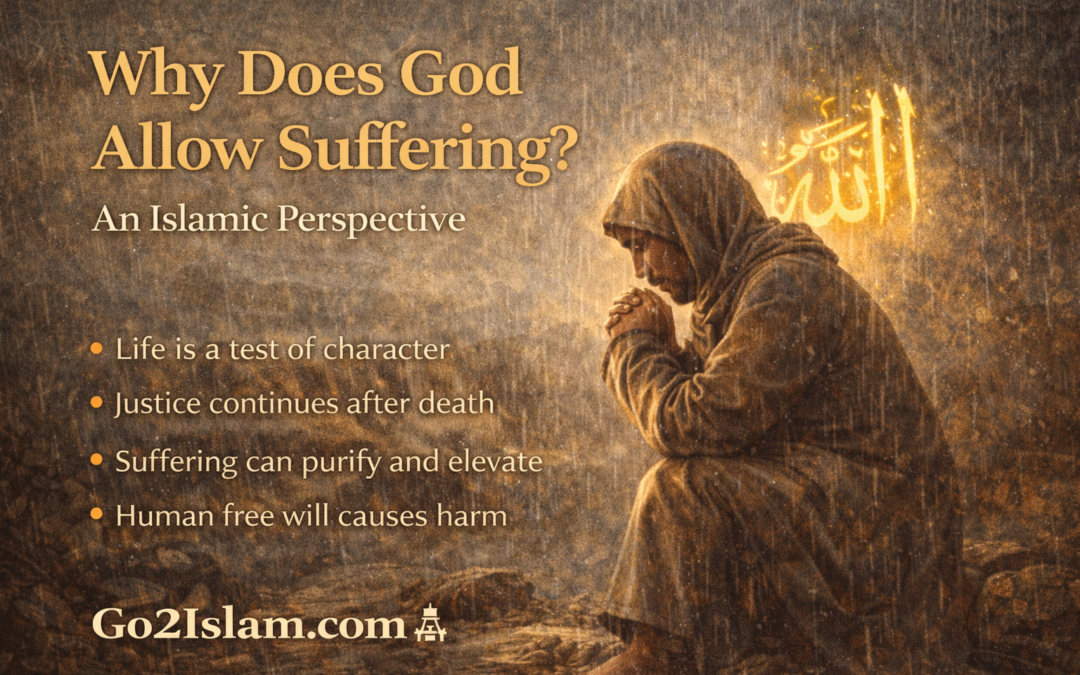
- This world is a test.
- Justice is not complete here.
- Suffering can purify and elevate.
- Human free will causes some pain.
- The afterlife completes the story.
Pain does not mean life is meaningless.
It means this world is not the final chapter.
And no suffering is unseen by the Creator.
SEO Setup
Focus Keyword:
Why Does God Allow Suffering
Meta Title:
Why Does God Allow Suffering? An Islamic Perspective
Meta Description:
Why does God allow pain and suffering? Discover the Islamic explanation of life as a test, divine justice, free will, and hope beyond this world.
Slug:
why-does-god-allow-suffering
FAQ Section (Add FAQ Schema in Rank Math)
Why does Islam say suffering exists?
Islam teaches that life is a test and suffering can serve spiritual growth, purification, and preparation for the afterlife.
Does suffering mean God is punishing someone?
Not necessarily. Suffering can be a test, a purification, or a means of elevating a person’s spiritual rank.
Why do innocent people suffer?
Islam teaches that this world is temporary and ultimate justice is delivered in the afterlife, where no injustice remains unresolved.
Is it wrong to question suffering in Islam?
No. Islam encourages reflection and seeking understanding while maintaining trust in God’s wisdom.